CUDA-X libraries: NVIDIA CUDA-X Adds GPU Tools for Faster Scientific Computing
NVIDIA expands CUDA-X libraries for scientific computing, with tools for astronomy, molecular simulations and biology. See reported gains and open
AI summary
The additions include cuPhoton, cuPotential and cuSpa, alongside updates and integrations for other GPU-accelerated research tools. NVIDIA describes applications across astrophysics, fusion research, drug discovery, materials science and biology, with reported speedups ranging from 3x to 900x in specific workflows. For researchers, the practical question is whether those gains carry over to their own software, data and hardware.
CUDA-X libraries — NVIDIA has expanded its CUDA-X library lineup with tools aimed at speeding up scientific computing, from black-hole data processing to molecular simulations and single-cell analysis.
Key takeaways
- NVIDIA CUDA-X libraries add GPU tools for scientific computing, including cuPhoton for data-intensive astronomy and fusion workflows.
- NVIDIA reports cuPotential can accelerate molecular simulations by up to 3x, while cuSpa supports spatial biology calculations.
- The cited speedups come from specific research workflows; broader performance and hardware requirements are not detailed in the announcement.
What changed
NVIDIA has expanded its CUDA-X collection with libraries and modules for research workloads that involve large datasets or repeated calculations. The announcement highlights cuPhoton, cuPotential and cuSpa, while also describing Daviator, DAQIRI, rapids-singlecell and a GPU-accelerated HMMER library. These tools target distinct scientific tasks rather than a single general-purpose research application.
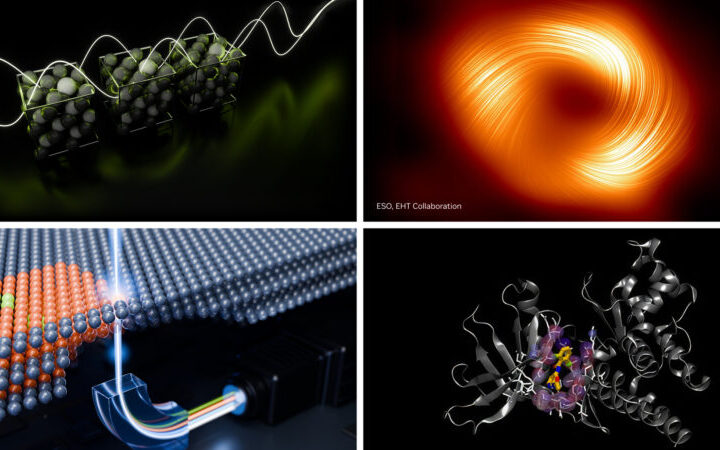
For astronomy, the cuPhoton.xBeam module is intended to correlate observations gathered by the Event Horizon Telescope, whose network of radio dishes produces petabytes of data. NVIDIA says a process that previously took more than a month can now take eight minutes. The company also describes cuPhoton.xLens as a way for Pacific Fusion researchers to inspect simulation results as plasma calculations run, rather than waiting for a simulation or experiment to finish before beginning analysis.
In molecular research, NVIDIA says cuPotential accelerates existing simulation software by up to 3x while improving calculation stability and accuracy. The library builds on work by researchers at the Simons Foundation’s Flatiron Institute and D. E. Shaw Research. NVIDIA says it is working with Schrödinger and communities around AMBER, NAMD, GROMACS, LAMMPS and the Open Molecular Software Foundation to bring the acceleration into molecular dynamics workflows.
Other additions address materials research and biology. NVIDIA says Daviator, a set of batched GPU kernels for the Vienna Ab initio Simulation Package, is coming to NVIDIA ALCHEMI, with quantum-mechanical calculations up to 22x faster and at up to 75% lower cost. The open-source cuSpa library speeds cell-polygon calculations, while rapids-singlecell is available in an agent-ready container; NVIDIA also describes its GPU-accelerated HMMER library as open source.
Why it matters
Analysis: The notable shift is not just faster calculation; some of these tools are designed to bring analysis closer to the experiment or simulation itself. That can give researchers a chance to inspect emerging results and decide what to examine next, instead of treating analysis as a separate stage after data collection. In fields where experiments generate data faster than conventional pipelines can handle, that timing may be as important as raw throughput.
The announcement also points to a broader role for AI agents in scientific workflows. NVIDIA says a locally running Nemotron-powered agent can be coupled with the fusion-analysis pipeline to support interactive analysis and help steer simulations. That describes a possible workflow, not evidence that an agent can autonomously validate findings or make research decisions safely; those capabilities are not established in the supplied announcement.
Performance figures need context. A stated 900x speedup for cuSpa, 200x faster processing with rapids-singlecell at Therna Biosciences, and up to 84x faster benchmark searches with NVIDIA’s HMMER library refer to different tasks and comparisons. They show why GPU acceleration attracts research teams, but they do not provide a like-for-like measure across tools or guarantee the same gains on another dataset or system.
Who is affected
Researchers working with radio astronomy, plasma simulations, molecular dynamics, materials modeling and spatial or single-cell biology are the most direct audience. The named examples include Pacific Fusion, Memorial Sloan Kettering Cancer Center, Lawrence Berkeley National Laboratory, Therna Biosciences and Basecamp Research. NVIDIA also says 10x Genomics integrated rapids-singlecell into its Sentira platform, extending the relevance to academic researchers, biopharma teams and foundation-model developers using that platform.
Software developers and research infrastructure teams may also need to assess the integration work. NVIDIA says it is collaborating with established molecular simulation projects and software communities, but the announcement does not specify compatibility details, deployment requirements or availability schedules for every library. Those omissions matter for teams deciding whether a tool fits an existing pipeline rather than a demonstration workflow.
For readers outside research labs, the effects are indirect. Faster simulation and analysis could support work on medicines, materials and biological models, but the source does not report a resulting drug, clinical outcome or completed discovery attributable to these tools. Treat the examples as computing-workflow claims, not proof of a downstream scientific or medical result.
What to watch next
First, look for technical documentation that spells out supported hardware, software versions, data formats and installation steps. Those details will help researchers determine whether the headline performance claims apply to their systems. The announcement identifies several tools as open source or integrated into named platforms, but it does not provide a complete compatibility matrix in the supplied text.
Second, watch for independent evaluations that use clearly described baselines and representative workloads. The reported figures compare different tasks and, in some cases, different systems, so the measurement setup is essential to judging practical value. NVIDIA’s announcement does not supply enough methodological detail to compare those results directly.
Finally, the agent-assisted fusion workflow raises a useful operational question: how researchers will review recommendations and retain control over simulation choices. NVIDIA describes interactive analysis as a way to inform real-time steering, but the supplied material does not explain the agent’s safeguards or decision boundaries. Those are important details before treating agent support as more than an analysis aid.
Frequently asked questions
What is NVIDIA CUDA-X?
CUDA-X is NVIDIA’s collection of GPU-accelerated libraries and tools for specialized computing tasks. In this announcement, NVIDIA describes additions and integrations aimed at scientific research, including astronomy, molecular simulation, materials science and biology.
What does NVIDIA cuPotential accelerate?
cuPotential is designed to accelerate molecular simulations used to evaluate drug designs and study molecular interactions. NVIDIA says it can speed existing simulation software by up to 3x; the announcement does not provide a single benchmark applicable to every supported workflow.
Is NVIDIA cuSpa open source?
Yes. NVIDIA describes cuSpa as newly open source and says it accelerates cell-polygon calculations used to generate spatial graphs. The supplied announcement does not state licensing terms or provide detailed installation instructions.
TechnoRapper used NVIDIA’s supplied announcement as the source for the named tools, reported performance figures and research examples; the figures are presented as company-reported claims, not independently verified results.
Related on TechnoRapper
- Treasury CIO Legatum: Treasury CIO’s Legatum Updates Collided With a FinCEN
- Rings of Power Season 4 Moves Into Pre-Production for 2027 Filming
- MCU X-Men era: Marvel’s X-Men Era Takes Shape After Secret Wars
- Russia’s Reported Orbital Nuclear Weapon Raises Satellite Risks
- Meta net-zero goal: Meta’s AI Expansion Puts Its 2030 Net-Zero Target Under
Inspired by: NVIDIA
How we used the source: facts, quotes, and numbers in this article come only from that Inspired by link. We added structure, search intent, and reader context. We did not independently verify the reporting.
Permanent link · https://technorapper.com/2026/11/cuda-x-libraries/