Slate Auto Screenless GPS: Slate Auto’s Screenless GPS Brings the Road Atlas
Slate Auto Screenless GPS replaces built-in navigation with a spiral-bound atlas. See what the truck’s basic dashboard means for drivers and device use.
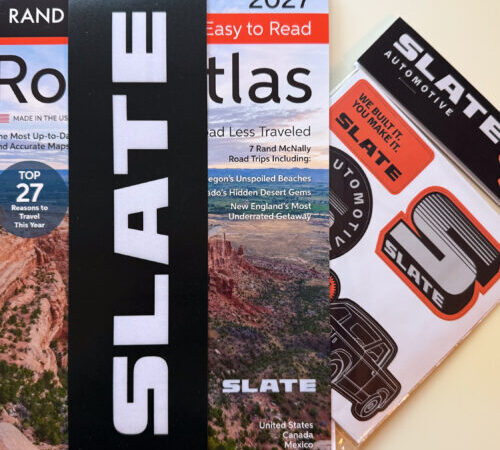
Slate Auto Screenless GPS — Slate Auto’s Screenless GPS is a spiral-bound road atlas offered as the navigation answer for its electric truck, which has no embedded infotainment system.
Key takeaways
- Slate Auto’s Screenless GPS is a road atlas for drivers seeking directions without an in-dash navigation screen.
- The startup says its electric truck skips embedded infotainment and leaves owners to choose their own devices.
- The atlas is a supplied accessory, but the source says it was not tested in a Slate truck.
What changed: Slate Auto’s Screenless GPS
Slate Auto has turned an old-school road atlas into a deliberate part of its pitch for a basic electric truck. Its so-called Screenless GPS is a spiral-bound map book, not a digital navigation device, and the company presents it as an option for drivers who do not want an integrated screen.
That choice fits a truck designed around omissions as much as features. Ars Technica reports that Slate’s vehicle has no embedded infotainment system; the compact dashboard display shows speed and range, and switches to the backup-camera view when the driver selects reverse.
The truck does include two USB-C ports, but they provide power rather than a data connection. In practice, Slate is not supplying a built-in route-planning interface or a way to connect a phone to the vehicle’s display, according to the source.
Instead, Slate says customers should use devices they already know and like. Its atlas makes that idea unusually literal: drivers can navigate with printed maps, while the truck itself stays free of an integrated infotainment setup.
Why it matters
For buyers comparing electric trucks, the decision affects how navigation works during everyday driving. A built-in system keeps directions on the dashboard, while Slate’s approach asks owners to rely on a paper map or bring their own device and plan around the truck’s limited connectivity features.
That trade-off may appeal to people who prefer a simpler cabin or do not want another screen built into a vehicle. However, a road atlas works differently from live digital navigation: the source describes it as a traditional map book, not a service that provides connected directions.
The idea also gives Slate’s broader product pitch a concrete example. The company is aiming for an affordable electric truck with basic equipment and a starting price below $25,000, while asking owners to handle some choices themselves. The atlas signals that “bring your own” can mean more than selecting an app or phone mount.
Analysis: The atlas is more than a nostalgic accessory because it shows what Slate means by leaving technology decisions to owners. The practical question for a potential buyer is whether a simpler dashboard outweighs the convenience of integrated navigation; the available source does not establish how owners will answer that question.
Who is affected
Slate’s approach matters most to prospective buyers who want an electric truck but have specific preferences about screens, navigation, or built-in connectivity. Drivers who are comfortable reading paper maps may see the atlas as a usable alternative, while those who expect dashboard directions should account for the absence of embedded infotainment.
It also affects owners who plan to use personal devices in the cabin. The truck’s USB-C ports supply power, but the source says they do not provide connectivity, so buyers should not assume they can link a phone to the vehicle’s display through those ports.
There is an important limit to what can be concluded about the experience. Ars Technica says it received an atlas from the automaker but did not have a Slate truck available for testing; therefore, the report describes the product and its stated concept, not a road test of navigation in the vehicle.
What to watch next
Potential buyers should look for more detail about how Slate expects drivers to use personal navigation devices alongside the truck’s dashboard. The source establishes that the vehicle lacks built-in infotainment and that its USB-C ports are power-only, but it does not explain any additional mounting or device-integration options.
It will also be worth watching how the atlas fits into the truck’s final ownership proposition. Slate’s starting-price pitch and stripped-back equipment are connected, but the supplied report does not say whether the atlas is standard, optional, or how it is packaged with the vehicle.
Finally, a hands-on account from someone using the atlas in a Slate truck would address a gap in the current reporting. Until then, readers can treat Screenless GPS as a clear statement of Slate’s design philosophy, rather than proof that paper maps will suit every driver or trip.
Frequently asked questions
What is Slate Auto’s Screenless GPS?
It is a spiral-bound road atlas that Slate offers as a paper-based navigation option for its electric truck. The company’s approach avoids an embedded infotainment system.
Does the Slate truck have a built-in navigation screen?
The source says the truck has no embedded infotainment system. Its small dashboard display shows speed and range, and it displays the backup camera when the vehicle is put in reverse.
Can a phone connect to the Slate truck through USB-C?
The source reports that the truck has two USB-C ports for power, but not connectivity. It does not provide further details about other ways owners might use personal devices for navigation.
Related on TechnoRapper
- AWS Data Loss Puts Ukraine’s Cloud Resilience Lessons in Focus
- Starshield Speed Limit Raises Questions About Ukraine’s Drone Connectivity
- Google Gemini School Rollout Faces Calls for a Pause
- FAA Ground Stop Ends, but Flight Delays May Continue
- Amazon product index: Amazon’s World Product Graph Could Keep Product
Inspired by: Ars Technica
How we used the source: facts, quotes, and numbers in this article come only from that Inspired by link. We added structure, search intent, and reader context. We did not independently verify the reporting.
Permanent link · https://technorapper.com/2026/11/slate-auto-screenless-gps/