Pangram AI Detector Enters a Dispute Over Defense Filings
Pangram AI detector results became evidence in a Texas court dispute over AI-assisted defense filings, disclosure rules and lawyers’ responsibility.
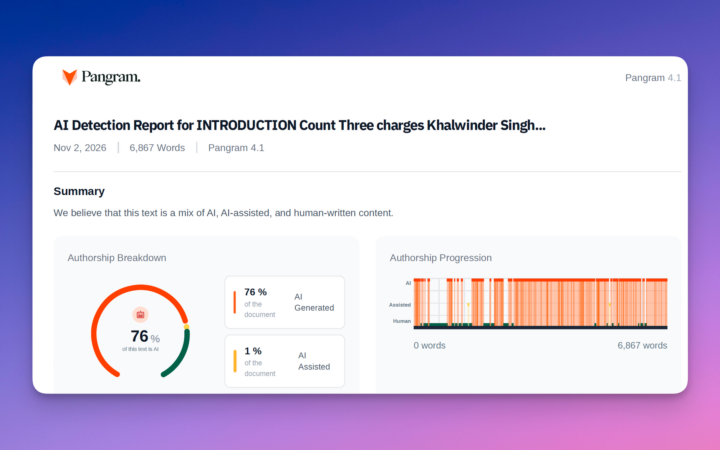
Pangram AI detector results have become part of a dispute over whether defense lawyers used generative AI to prepare court filings in a Texas voter-fraud case. The disagreement raises a practical question for legal teams: how should courts weigh AI-detection scores when the lawyers on both sides contest what those scores can establish?
Key takeaways
- The Pangram AI detector was used by prosecutors to assess defense filings in the Bhengura case.
- The defense acknowledged some AI assistance but disputed the government’s claims about authorship and the value of Pangram’s results.
- A Northern District of Texas rule requires lawyers to disclose generative AI use in court filings.
- The Pangram AI detector was used by federal prosecutors to assess defense filings, and its results became exhibits in their argument.
- The defense acknowledged using AI on some documents, while disputing the government’s characterization of the work and the detector’s evidentiary value.
- The case unfolds under a Northern District of Texas rule requiring lawyers to disclose generative AI use in filings.
What changed
The Department of Justice has brought AI-writing detection into a courtroom dispute over defense submissions in the case of Khalwinder Bhengura. According to court filings reviewed by 404 Media, government lawyers ran several defense filings through Pangram and attached the results to an argument that they should not have to respond substantively to work they considered largely AI-generated.
The detector’s results were mixed: they did not indicate that the briefs were entirely produced by AI. Still, prosecutors argued that much of the material not flagged as AI consisted of quotations, evidence, or other third-party text, and claimed little substantive writing came from the defense team. They described the filings as “defense by ChatGPT,” a characterization the defense rejected.
The defense did not deny all AI use. Attorney Mario Herrera said some portions were prepared with AI assistance and then reviewed and edited by him, while maintaining that he wrote the arguments and stood behind their reasoning. The dispute therefore concerns both the use of AI itself and what the detector’s output can show about authorship, legal accuracy, and responsibility.
There is a local rule in the Northern District of Texas requiring lawyers to disclose generative AI use in filings. Some defense submissions included that disclosure. The judge, Mark Pittman, criticized the defense lawyers’ filings as superficially persuasive but meritless, and expressed concern about AI’s effect on advocacy.
Why it matters
For lawyers and clients, an AI detector’s result can carry consequences beyond a debate about drafting tools. Here, prosecutors used the results to support a request to limit the effort they put into answering defense motions, while the judge’s criticism put the quality of the defense’s work under scrutiny.
But a detection score is not the same thing as a finding about who wrote a document or whether its legal claims are sound. Herrera argued that Pangram could identify writing patterns but could not establish authorship, explain how a document was prepared, or determine whether its legal reasoning was correct. The mixed results described in the filings make that distinction especially relevant.
Analysis: The broader issue is how courts distinguish responsible assistance from unreliable work when lawyers use generative AI. The sourced account does not establish a general legal standard for doing so; it shows one case in which disclosure, detector output, judicial criticism, and the lawyers’ own explanations all became part of the dispute. TechnoRapper’s account uses 404 Media’s reporting and the statements and filings it describes, while keeping the disputed claims attributed to the parties who made them.
The matter also sits within a wider pattern of legal professionals scrutinizing one another’s AI use. The source notes that attorneys, including government lawyers, have increasingly tried to identify AI-assisted work, amid earlier incidents in which lawyers faced criticism for citing nonexistent cases. That context makes accuracy and review important concerns, but it does not establish that every AI-assisted filing is flawed.
Who is affected
Bhengura is at the center of the case. The source reports that he is a 70-year-old Indian man, speaks Punjabi, has limited English, and entered the United States on an immigrant visa in 2022. He was accused of lying about citizenship, registering to vote unlawfully, and voting unlawfully after a driver’s-license application falsely stated he was a U.S. citizen.
A jury found him guilty on two of the three counts and not guilty on one. His lawyers have argued that he did not knowingly claim U.S. citizenship and that the situation involved a misunderstanding. The source says he has remained in custody since the verdict and faces deportation; the AI dispute is therefore unfolding alongside serious consequences for their client.
The defense attorneys are also directly affected. Herrera said lead attorney Nicole Knox experienced a medical emergency while they were at the U.S. Attorney’s Office, leaving him to prepare for a federal jury trial in four days with new co-counsel. He said AI helped him manage multiple tasks under that deadline, while Knox said the disclosure rule requires reporting even limited AI assistance.
Government lawyers and judges have a stake as well: they must assess filings and decide how to respond when opposing counsel uses AI. Pangram CEO Max Spero told 404 Media he had heard anecdotally of law firms using the software, often internally to check whether junior lawyers and paralegals use AI to draft briefs. The report does not establish how widely courts or firms use such tools.
What to watch next
The immediate questions are how the court handles the disputed filings and how the case proceeds for Bhengura. The source describes a conviction on two counts, an acquittal on one, and the prospect of deportation, but does not provide a final sentence or a later ruling resolving the AI-detection dispute.
Readers should also watch how the Northern District of Texas’s disclosure rule shapes arguments about AI-assisted work. In this case, disclosure did not end the disagreement: the defense cited its use of AI, while prosecutors relied on Pangram results to argue that the filings warranted less substantive engagement.
More broadly, the case puts pressure on lawyers to explain how they use AI and what human review follows. The source leaves open whether detector results will be treated as useful signals, limited evidence, or something that needs stronger support before courts rely on them. That uncertainty matters to anyone whose legal representation depends on careful drafting and review.
Frequently asked questions
What did Pangram do in the Bhengura case?
Government lawyers used Pangram to analyze several defense filings and submitted its results as exhibits. The results were mixed and did not show that the briefs were entirely AI-written.
Did the defense admit to using AI?
Yes. Herrera said some parts of filings received AI assistance, then were reviewed and edited by him. He maintained that he wrote the arguments and accepted responsibility for their logic.
Why is AI use being disclosed in this court?
The federal court in the Northern District of Texas recently implemented a rule requiring attorneys to disclose generative AI use in filings. Some defense documents included that disclosure, but the parties still disputed what the AI use and detector results meant.
Related on TechnoRapper
- Grok Bot account access: Grok Bot’s Unapproved Account Access Raises
- Megaspeed investigation: Nvidia AI Chip Shipments to China Draw US Probe Into
- OpenAI California lawsuit: OpenAI Faces a California Lawsuit Over the Hugging
- Intel Shareholder Lawsuit Puts PC Sales Disclosures Under Scrutiny
- OpenAI AI agents: California Targets OpenAI’s AI Agents Over 80
Inspired by: 404 Media
How we used the source: facts, quotes, and numbers in this article come only from that Inspired by link. We added structure, search intent, and reader context. We did not independently verify the reporting.
Permanent link · https://technorapper.com/2026/11/pangram-ai-detector/