J0008+0128 neutron star: J0008+0128’s Hidden Neutron Star Sits in a Stellar
The J0008+0128 neutron star may weigh up to 2.8 Suns, but its wide orbit and uncertain formation leave astronomers with a difficult stellar puzzle.
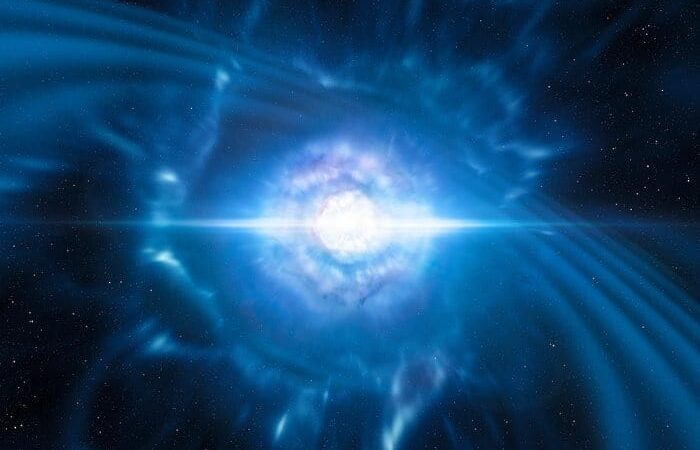
J0008+0128 neutron star — J0008+0128 contains an unseen companion that may weigh up to 2.8 times the Sun, putting it in the poorly understood mass gap between neutron stars and black holes.
Key takeaways
- J0008+0128 neutron star: The unseen object may reach 2.8 solar masses, potentially placing it in the gap between neutron stars and black holes.
- Astronomers detected the object by measuring its gravitational effect on a red giant companion.
- Thousands of simulations did not reproduce the system’s unusual mass and wide orbit, leaving its formation uncertain.
What changed: J0008+0128 neutron star challenges the usual categories
Astronomers have identified a hidden compact object in the system J0008+0128, and measurements suggest it could be an unusually massive neutron star. The object does not shine as an ordinary visible companion; researchers inferred its presence from how its gravity affects a red giant star.
The study, published in Science Advances, estimates that the unseen object could have up to 2.8 times the Sun’s mass. That would place it within the so-called mass gap, a region from roughly 2.5 to five solar masses where astronomers have found relatively few stellar remnants.
Neutron stars and black holes are both possible remains of massive stars after a supernova. The new result does not settle exactly what the J0008+0128 object is, but its possible mass makes it an important candidate for testing where neutron stars end and black holes begin.
The TechnoRapper editorial desk used the supplied 404 Media report and its account of the study as the source for this article. The report identifies Song Wang, an associate researcher at the National Astronomical Observatories of the Chinese Academy of Sciences, as a study co-author.
Why it matters
Neutron-star measurements can help researchers investigate the equation of state: the relationship between the extreme pressure and density inside these objects. The source describes this as a long-standing problem in astrophysics, and notes that the maximum mass a neutron star can withstand depends on how its internal matter resists gravitational collapse.
A well-measured object near the upper end of neutron-star masses could therefore test competing explanations of matter under immense density. If the J0008+0128 companion is confirmed as a supermassive neutron star, it could help narrow which descriptions of that matter fit the evidence.
There is a second puzzle. The object orbits its red giant at a reported interval of 1,218 days, a separation that makes it difficult to explain how it could have grown by pulling material from that companion. Researchers ran thousands of simulations, but the study’s team could not reproduce the system’s observed physical and orbital properties.
Analysis: The importance for readers is scientific rather than a change to a consumer device or service. The system matters because it may help improve understanding of stellar evolution and of neutron-star mergers, events that can be studied through gravitational waves.
Who is affected
The immediate audience for this finding is the astronomy community, especially researchers studying stellar remnants, supernovae, binary-star evolution and neutron-star interiors. The results also matter to scientists who use gravitational-wave observations to study the dynamics of compact-object mergers.
For now, the finding does not establish a new general rule about how massive stars die. The source stresses that J0008+0128 is an unusual system and that its mass remains a possibility to refine, rather than a final answer to the mass-gap question.
People following the Gaia space telescope’s survey work also have a reason to watch this case. The team used Gaia astrometric data alongside other large sky surveys to identify the system and hopes future data will help narrow the unseen companion’s mass.
What to watch next
The next key development is the forthcoming Gaia data release, which the source says was due the month after the study report. Researchers hope the new data will reduce uncertainty about the object’s mass; the supplied material does not provide a confirmed result from that release.
A clearer mass estimate could strengthen or weaken the case that the companion occupies the mass gap. Even with better measurements, however, astronomers will still need to explain how the system formed and why its wide orbit differs from outcomes produced in the team’s simulations.
The researchers outlined several possibilities rather than a settled explanation. A rare supernova might create a massive neutron star directly, or the system could once have held three objects, with two merging to form the object now observed.
The source also points to Gaia BH2 and G3425 as other compact-object systems that challenge standard models. Further study of J0008+0128 and similar systems may show whether these are isolated exceptions or signs that binary evolution and supernova theories need revision.
Frequently asked questions
What is the hidden object in J0008+0128?
The object is a compact, unseen companion to a red giant star. Researchers think it may be a supermassive neutron star, but its nature and exact mass remain uncertain.
Why is the object’s possible mass unusual?
Its estimated upper mass of 2.8 times the Sun could put it in the sparsely populated range between neutron stars and black holes. Astronomers have long questioned how stellar remnants form in this mass gap.
How could Gaia data help clarify the discovery?
The study team hopes forthcoming Gaia survey data will narrow the possible mass of the unseen companion. A more precise estimate would help researchers assess whether it belongs in the mass gap, although it may not explain the system’s unusual orbit.
Related on TechnoRapper
- All-In affordability debate: All-In Hosts Struggle to Explain Voters’ Anger
- Pokémon Card Queue Leaves Charleston Father Facing Child Charge
- UK Adult Content Law Puts Fetish Videos and Private Recordings at Risk
- Clips4Sale UK restrictions: Clips4Sale Limits UK Video Access as New Porn Law
- Meta AI terms: Meta AI Training Terms Put on Hold After Website Data Backlash
Inspired by: 404 Media
How we used the source: facts, quotes, and numbers in this article come only from that Inspired by link. We added structure, search intent, and reader context. We did not independently verify the reporting.
Permanent link · https://technorapper.com/2026/11/j0008-0128-neutron-star/