Apple Health AI study: Apple’s Health AI Study Puts Answer Quality to the Test
Apple Health AI study invites people to rate medical answers for accuracy, detail, and relevance in a new iOS app, with OpenEvidence as a partner.
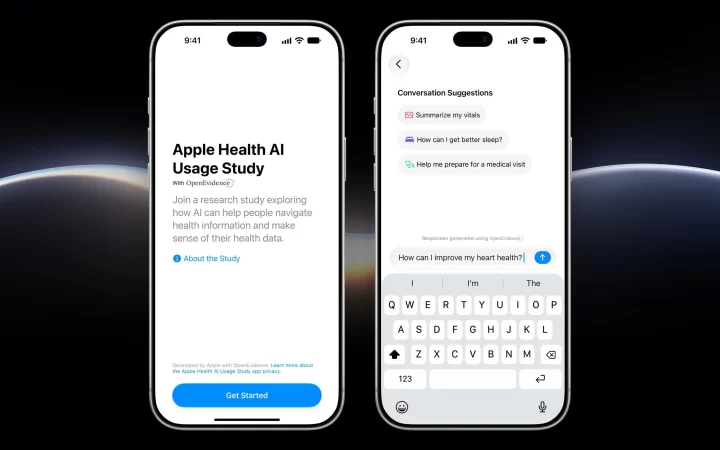
Apple Health AI study — Apple’s Health AI study asks participants to assess how accurate, detailed, and relevant conversational AI answers to medical questions are.
Key takeaways
- The Apple Health AI study lets participants ask medical questions in a new iOS app and rate the AI responses.
- Apple is working with OpenEvidence, a clinical AI platform used by healthcare professionals.
- Enrollment starts as the app becomes available, but the supplied report does not specify how long the study will run or what results Apple will publish.
What changed
Apple has opened a study designed to learn how people use conversational AI for health questions and whether the answers help them. Participants use a new iOS app to ask medical questions, then evaluate the responses for accuracy, detail, and relevance.
The project is called the Apple Health AI Usage Study. Apple is conducting it with OpenEvidence, a clinical AI platform used by healthcare professionals that generates answers based on medical information, including material from sources such as The New England Journal of Medicine.
The Verge reports that the app is available to download and that enrollment begins alongside the announcement. Its account does not provide additional details about eligibility, the number of participants, the study’s timeline, or when Apple might share findings.
TechnoRapper’s editorial desk used The Verge’s report as the source for the study’s stated purpose, partner, app-based participant process, and evaluation criteria. Those reported details describe a research project, not evidence that an AI health tool can diagnose conditions or replace professional medical care.
Why it matters
Analysis: For people considering conversational AI for health questions, the study focuses on a practical issue: whether users find responses useful across several dimensions, rather than simply whether a tool can produce an answer. Accuracy, detail, and relevance can affect how a person interprets information, so asking participants to rate them may help Apple examine how such tools work in real interactions.
The collaboration also connects a consumer-facing study with a platform already used by healthcare professionals. OpenEvidence’s answers draw on medical information, and the source identifies The New England Journal of Medicine as one example of a source; it does not say that every answer uses that publication or explain how the system selects its material.
There is a meaningful limit to what the announcement establishes. Participant ratings can reveal perceptions of answer quality, but the supplied report does not say that the study independently verifies medical correctness or measures health outcomes. Readers should therefore treat the effort as an investigation into use and usefulness, not as a new clinical endorsement.
Who is affected
People who choose to enroll are the direct participants: they will ask health-related questions through the iOS app and rate the resulting answers. The report does not identify eligibility rules or say whether participation is limited to a particular group, so those details remain unclear from the available information.
Apple is the company leading the study, while OpenEvidence is its named collaborator. Healthcare professionals may also have an interest because OpenEvidence is described as a clinical AI platform used by that community, although the source does not say that clinicians will take part in this particular study.
For other readers, the immediate relevance is informational rather than a confirmed change to a health service. The announcement concerns research into conversational AI responses; it does not report a new Apple health product or a change to existing medical care.
What to watch next
First, prospective participants will want to check the app’s enrollment information for practical requirements that the report does not spell out. The announcement confirms that the app is available and enrollment starts, but it does not provide enough detail here to establish who can join or how long participation takes.
Next, watch for information about how Apple will use the ratings. The reported criteria are accuracy, detail, and relevance, but the source does not describe the study’s evaluation method, how researchers will compare responses, or whether participants’ feedback will be released publicly.
Finally, any future results will matter most if they clarify what the ratings can and cannot show. Until Apple shares more, the study’s stated goal is to understand people’s interactions with AI health tools and the usefulness of the answers they receive; its announcement alone does not establish that those answers are medically reliable.
Frequently asked questions
What is Apple’s Health AI study?
The Apple Health AI Usage Study examines how people interact with conversational AI health tools and how useful they find the answers. Participants ask medical questions in an iOS app and rate responses.
How do participants evaluate the AI answers?
Participants rate answers based on criteria that include accuracy, detail, and relevance. The supplied report does not explain the scoring process beyond those criteria.
Who is working with Apple on the study?
Apple is collaborating with OpenEvidence, a clinical AI platform used by healthcare professionals. The source says its answers draw on medical information from sources such as The New England Journal of Medicine.
Related on TechnoRapper
- Hydra Captain America: Captain America #17 Reveals Who Is Protecting Vic—and
- Hellions tragedy: X-Men United Rewrites the Hellions’ Tragedy Around Emma
- Jensen Huang CEO return: Nvidia CEO Return Rumors Put Jensen Huang’s
- Amazon Leo’s 40-Satellite Launch Ends After Vulcan Rocket Anomaly
- Nvidia Testimony Demands Have Not Changed AI Chip Export Rules
Inspired by: The Verge
How we used the source: facts, quotes, and numbers in this article come only from that Inspired by link. We added structure, search intent, and reader context. We did not independently verify the reporting.
Permanent link · https://technorapper.com/2026/11/apple-health-ai-study/