SpaceX Starship Tower Catch Shows Progress Toward Rocket Reuse
The Starship tower catch shows SpaceX can return the upper stage to its launch tower. Here is what the demonstration proves—and what remains unknown.
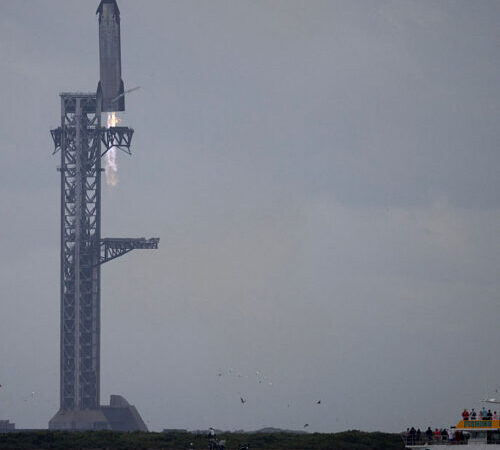
Starship tower catch — SpaceX has demonstrated that its Starship upper stage can return from flight and be caught by the launch tower, a step toward making the massive rocket rapidly reusable.
Key takeaways
- SpaceX Starship tower catch demonstrates that the upper stage can return from flight and be secured by the launch tower.
- The maneuver depends on a precise final descent and two small protrusions that meet the tower’s arms.
- The catch advances reuse development, but it does not by itself establish routine or rapid Starship operations.
What changed
SpaceX has demonstrated a tower catch of Starship’s upper stage after flight. The vehicle descended through a cloud layer, turned upright near the tower and settled onto two extended arms, completing a return maneuver that the company is developing as part of its reusable rocket design.
The account in Ars Technica describes the upper stage approaching in a horizontal orientation before three Raptor engines fired to bring it vertical. The tower’s arms then caught the vehicle by small protrusions on its sides, leaving little room for error during the final alignment.
This was not simply a landing on a prepared surface. The tower itself received the returning stage, making the catch a demonstration of how Starship could be handled at the launch site. Ars Technica characterizes the flight as a significant step in developing and optimizing a large, rapidly reusable rocket.
The source gives no further flight details, such as the mission’s broader objectives or how the vehicle performed after the catch. This article uses Ars Technica’s report as its factual basis and does not infer additional test results.
Why it matters
Analysis: Reuse matters because SpaceX’s stated development goal is a rocket that can fly again quickly, rather than requiring a wholly new vehicle for each mission. A successful catch demonstrates one part of that ambition: returning the upper stage to the tower in a way that could support recovery at the launch site.
The maneuver also highlights how tightly linked the vehicle and launch infrastructure are. The stage must arrive at the right point, rotate into position and make contact with the tower arms; the account’s description of small contact points makes clear that the final seconds require precise coordination.
Still, one successful catch does not show how often SpaceX can repeat it, how much inspection or repair a returned stage may need, or whether the overall process will become rapid. Those questions matter to anyone following Starship’s development, but the supplied report does not answer them.
Who is affected
For readers following spaceflight and rocket engineering, the catch offers a visible milestone in the effort to make Starship reusable. It shows a specific recovery approach in action: instead of describing only a vehicle’s return, the report describes the launch tower receiving the upper stage directly.
SpaceX is directly affected because the company is pursuing the development and optimization of this large rocket. The result may inform its next steps, although the source does not report what those steps will be or whether the company has announced a schedule.
People looking for a practical change to access, cost or service should be cautious about drawing conclusions. The report establishes a notable recovery demonstration, not a change to passenger travel, commercial launches or the price of reaching space.
What to watch next
The central question is repeatability: whether Starship can perform the return and tower catch again. The source describes this catch as a significant step, but offers no evidence about a series of successful catches or a routine operating process.
Readers should also watch for information about what happens after the stage reaches the tower. A catch is only one part of reuse; the supplied report does not say how the vehicle is inspected, prepared for another flight or how long that work might take.
Further reporting may clarify how SpaceX evaluates the maneuver and what it aims to demonstrate next. Until then, the sound conclusion is narrow but important: the upper stage returned from flight and the tower caught it, while the broader promise of rapid reuse remains a development goal.
Frequently asked questions
What did SpaceX demonstrate with Starship?
SpaceX demonstrated the return of Starship’s upper stage to the launch tower, where extended arms caught it. Ars Technica describes the stage turning upright shortly before the catch.
How does the Starship tower catch work?
In the reported maneuver, three Raptor engines fired as the descending stage moved from a horizontal orientation toward vertical. Small protrusions on the vehicle met the tower’s extended arms, which secured it.
Does the catch mean Starship is ready for rapid reuse?
No such conclusion is supported by the report. The catch is described as a step toward developing and optimizing a rapidly reusable rocket, but the source gives no details about repeatability or turnaround time.
Related on TechnoRapper
- Avengers: Doomsday writing credits: Avengers: Doomsday Adds Ryan Reynolds and
- Descendants 6 tournament: Descendants 6 May Pair Elsa and Anna’s Children in
- Microsoft Outlook recovery: Microsoft Outlook Email Returns as 365 Recovery
- Cybercab personal offer: Tesla Cybercab’s $29,990 Personal Offer Comes With a
- CRKD Atom Plus Adds Dual Analog Sticks to a Pocket-Size Gamepad
Inspired by: Ars Technica
How we used the source: facts, quotes, and numbers in this article come only from that Inspired by link. We added structure, search intent, and reader context. We did not independently verify the reporting.
Permanent link · https://technorapper.com/2026/11/starship-tower-catch/